

Quick Start
The Oxen.ai chat completions API is fully OpenAI-compatible. You can use the OpenAI SDK,curl, or any HTTP client that speaks the OpenAI chat format.
Base URL: https://hub.oxen.ai/api/ai
Endpoint: POST /ai/chat/completions
Browse all available models.
Authentication
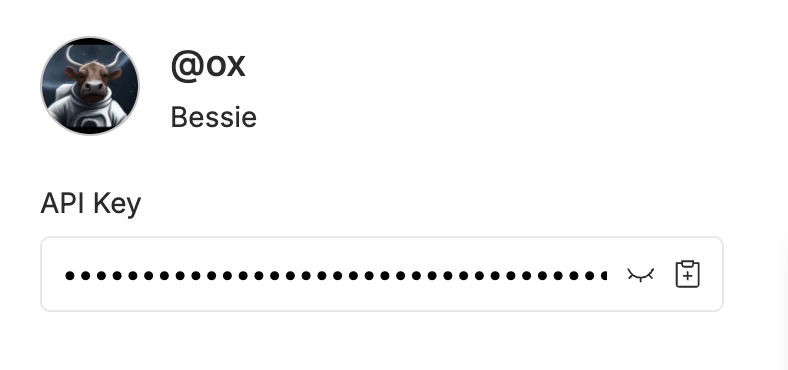
Every request requires a Bearer token in theAuthorization header. You can find your API key in your account settings.
Response Format
The API returns an OpenAI-compatible JSON response:Parameters
Messages
Each message in themessages array has a role and content:
Streaming
Set"stream": true to receive responses as server-sent events (SSE). Each event is a chat.completion.chunk object with a delta instead of a message.
data: and contains a JSON chunk:
Vision
Models that support vision (such asgemini-3-1-pro-preview or claude-sonnet-4-6) accept images in the messages array. For full details and examples including base64 encoding and video understanding, see Vision Language Models.
Documents (PDFs)
Attach a document with afile content part. Place the document before the text part for the best results.
Pass the file inline as a base64 data URL in file.file_data:
file.file_url. Pass
exactly one of file_data (a base64 data URL) or file_url; the URL
must be publicly accessible (and unexpired, if presigned).
application/pdf is supported, and a document must be 24 MB or
smaller; other inputs return a 400. Referencing files by OpenAI file_id is
not supported. Inline the file with file_data or pass file_url.
Audio
Attach audio with anaudio_url content part to a model that supports audio
input (such as gemini-3-1-pro-preview).
Place the audio part before the text part for the best results.
data: URL and pass it as the
audio_url:
Python (OpenAI SDK)
400. Supported formats vary by
provider: OpenAI audio models (e.g. gpt-audio) accept only wav and mp3,
while Gemini models (e.g. gemini-3-1-pro-preview) additionally accept m4a,
aac, ogg, and flac.
Tool use
Tool calling (function calling) follows the same OpenAI Chat Completions tool format. You send atools array describing each function’s JSON Schema; the model may reply with tool_calls instead of plain text. You execute those functions in your app, then send the results back in new tool messages so the model can finish the answer.
Raw curl: first request (tools only)
The model may respond with tool_calls instead of user-facing content:
tool_calls, and one tool message per call. Replace IDs and tool_calls with values from the first response. Repeat until finish_reason is "stop" (or "length") and there are no new tool_calls.
Follow-up request: curl and OpenAI Python SDK
The follow-up HTTP body matches what the OpenAI SDK builds when you append assistant and tool messages in a loop.
Errors
The API returns errors as JSON with anerror object and a standard HTTP status code.